
Focusing on the Person;
Consider, you are the hypothesis to comprehend the research method, as it is you that must determine the situational awareness of your region of interest.
Mission: Find issues or Crime
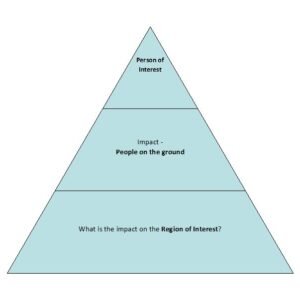
- A person of interest could be identified as the root of the issue
- They could impact people on the ground, or, the people on the ground could be the root of the issue for distinct reasons working together in concert
- All-of-the above could impact a region of interest be it, a location, industry/sector, or a cultural group
Professional Assessment for past 12 months, as it is the person that is the decision maker. What happened, and what did you learn? Professionals must take stock at the end of the year of experiences and decide to continue with successful habits or change habitual behaviour. When professionals are responsible for the lives of others and assets, then they would have the mentality to consider self-reflection on their situation – position and the implications. Perhaps, they may need to educate themselves in specific areas or build upon certain strengths.
We consider historic data (Modus Operandi – The Pattern) for the past year. If we did not make the type of progress we would like to have made or capable of making, then we must consider issues. For example; there is still a major and unacceptable level of theft of specific goods or higher cases of workplace violence, collateral damage relating to insider threats or outside influences, an example; could be xenophobic, racist or bias incited attacks or incidents.
Current challenges; Let us keep in mind that the threats or collateral damage is mostly done by people. It is not the weapon, equipment or any tangible object that creates crime or terror – it is people. Sure, we have weather conditions or earthquakes that do horrendous harm and devastation which must be considered, but for this exercise consider issues that are man-made.
The X-Factor: Perhaps there were issues that we were unaware of and now have been discovered. Not knowing them beforehand perhaps have caused collateral damage.
When one has suffered some form of disappointment or was betrayed by people, then it simply means that decisions were made based on unreliable of insufficient information. This could also mean, that perhaps other people could read you better while you were reading them and took advantage.
Consider: Security Success depends on the level of situational awareness of the decision maker on the ground and the reaction speed
- The level of situational awareness comprises Historic data, Current challenges, and the X Factor
- Decisions need to be based on reliable and all the information
- Reaction speed depends on SPI [Situation Position Implications]
We gather information from people to determine the situational awareness to make decisions
BUT
People lie, hide or volunteer information
Knowing if someone is lying is relatively easy
The point is to know the ”Why?” they are lying, hiding or sharing information.
Any decisions or reactions based on inaccurate or insufficient information will deliver collateral damage
- Comprehend the True Situation using reliable and ALL the information
- Clarify the Position to Make the Decision
- Considering the Implications on Actions that could be taken
- For the right reason under the right conditions – React timeous